
This page argues that podcasting has replaced the business book as the authority signal for commercial trust. Books built authority through gatekeepers: a publisher's investment vouched for the author. Podcasting builds authority through time in the listener's ear: hours of unedited voice is the hardest credential to fake. The mechanism is parasocial trust, the one-sided sense of knowing a media figure, first described by Horton and Wohl in 1956. It is real, powerful, and to be used honestly. The position is nuanced: podcasts replace books as the authority signal, not as the vessel of deep knowledge. Practically, most businesses should appear as guests on established shows before launching their own, and one long recording becomes short clips for every platform. AutoHive records at The Think Tank SA's walk-in podcasting studio.
Podcasting & trust
Nobody can fake forty hours in your ear.
A business book takes a year to write and ten hours to read. A podcast takes an afternoon to record, and its listeners spend more time with your actual voice than most authors ever get with a reader. Something important changed in how authority is earned, and it was not that people stopped valuing depth. This page explains what the microphone replaced, what it did not, and how a business should actually begin.

What the microphone replaced
Books vouched through gatekeepers. Podcasts vouch through time.
"He wrote the book on it" was never really about the book. It was about the gatekeepers behind it: a publisher risked its money and its name on the author, editors interrogated the manuscript, bookshops gave it shelf space. The physical object was a certificate of institutional vouching: you trusted the author because credible institutions had trusted them first. That system had real virtues, and its obvious weakness: the gate. Authority went to those the gatekeepers chose, and by the time self-publishing dissolved the gate, "author" had quietly stopped guaranteeing what it used to.
Podcasting replaces the institutional voucher with a brutal, democratic one: time in the listener's ear. No committee approves you, but no committee can save you either. Over hours of long-form conversation, a listener hears you think in real time: how you handle a question you did not expect, whether you say "I don't know" when you don't, whether your examples sound lived or rehearsed. A written page can be ghostwritten, polished, borrowed. Hours of unedited voice is the hardest credential to fake, because the faking would require the very fluency being tested. The format is the lie detector.
This is the same shift we describe across this site: from claimed authority to demonstrated authority. In writing, you demonstrate it through citation and correction. In audio, you demonstrate it by being audibly, repeatedly, unscriptedly yourself.
| The business book | The podcast | |
|---|---|---|
| Who vouches for you | Institutions: a publisher's money, an editor's scrutiny, a bookshop's shelf. | The listener's own ear, hour after hour. Nobody approves you; nobody can rescue you. |
| What it proves | That you can sustain a structured argument, or that your ghostwriter can. | That you think fluently about your field in real time. Ghostwriting has no microphone equivalent. |
| Time with your audience | Most business books are bought, sampled and shelved; finishing one is the exception. | Regular listeners accumulate hours in your company, often more than your closest clients get. |
| Best at carrying | Deep frameworks, rigorous argument, reference material. The vessel of knowledge. | Character, judgement, presence: the felt sense that a real person holds these views. The authority signal. |
| Shelf life | Years; a good book outlives its publication cycle and keeps credentialing quietly. | Episodes age fast, but the accumulated familiarity does not: the asset is the relationship, not the archive. |
| Honest conclusion | Write one when you have a body of knowledge to transmit. | Speak when you want your thinking audited by people who have not met you yet. Do both if you can. |
The mechanism, named honestly
Parasocial trust: real, powerful, and to be handled with clean hands.
The psychology here has a name, and naming it is part of using it honestly. In 1956, researchers Donald Horton and R. Richard Wohl described parasocial interaction: the one-sided sense of relationship an audience forms with a media figure who does not know they exist. Radio listeners felt they "knew" presenters they had never met. Podcasting is that effect at full strength: a voice, in your ears, often literally while you are alone, for hours at a stretch. Listeners come to feel they know a host the way they know a colleague: they can predict the laugh, finish the catchphrase, anticipate the objection.
We will not dress this up in invented percentages. The honest version is qualitative and it is enough: familiarity breeds trust, voice carries the cues of sincerity better than text, and repeated exposure does the compounding. That is precisely why the ethics matter. Parasocial trust is asymmetrical, the listener extends something the speaker cannot reciprocate, so exploiting it with manufactured intimacy or scripted "authenticity" is manipulation wearing trust's clothes. Our rule is the same one that governs our refusal to fake reviews: be genuinely worth trusting, then let the medium do honest work. Say what you know, admit what you don't, and let people hear the difference.

The ear audits spontaneity
How you answer the question you did not prepare for: the pause, the thinking-aloud, the willingness to revise mid-sentence. Text hides the seams of thought; audio broadcasts them. Listeners are not consciously scoring this, but they are absolutely registering it.
Test yourself on a real microphone
The ear audits consistency
Over many episodes, contradictions surface and postures collapse: no one maintains a performed persona across dozens of unscripted hours. What survives long exposure is who you actually are, which is why the medium rewards people whose public and private positions match.
Read why consistency is the brand
The ear audits humility
"I don't know" and "I was wrong about that", said aloud, build more credibility than any credential recited. The same principle powers our published-corrections policy in writing: visible fallibility is what makes the rest believable.
Read the corrections policyNow the nuance, because the strong version of this page's claim would be false. Podcasts are replacing books as the authority signal, not as the vessel of deep knowledge. A conversation cannot hold a rigorous argument the way two hundred structured pages can; books remain where deep frameworks live, and serious operators still read them. What the podcast has taken over is the book's other job: the business-card job, the "this person is credible" job that made people write books nobody expected to be read. If your goal is to transmit a body of knowledge, write. If your goal is to let a thousand potential clients audit your thinking before they ever meet you, speak. The wise do both, and let each medium do the job it is built for.
The practical half
Guest first. Launch later, if ever.
The graveyard of business podcasts is full of shows that died at episode seven: launched in enthusiasm, abandoned when the calendar bit back. A show is a publishing commitment: weekly production, booking, editing, distribution, forever. Most businesses should not start there.

Borrow audiences as a guest
Appearing on established shows gives you the medium's trust-building power with none of the production burden, and puts you in front of audiences someone else spent years assembling. Ten good guest appearances will teach you whether you are compelling on a microphone before you bet a content calendar on it. The host's platform vouches for you, the hours do the rest.
Map my guesting route
One recording, every platform
A single hour of honest conversation is raw material for weeks: short vertical clips for Reels, TikTok and Shorts, quote graphics for LinkedIn, an article for your blog, an episode for the feed. The long-form builds the trust; the clips go find the people. The social and video page explains which platforms deserve which cuts, and which shouldn't get any.
See which platforms get which cuts
Launch a show when the maths says so
Start your own show when three things are true: guesting has proven you hold attention, you have a defensible niche an existing show does not serve, and someone owns production so it survives your busiest quarter. Then treat it like the asset it is: your feed, your files, your subscriber relationships, owned by you, like every other asset we manage.
Own the show's assetsMeasurement deserves one honest sentence: podcast attribution is looser than ad attribution: listens do not click, and the client who heard forty episodes will simply arrive one day saying "I feel like I know you." You will see the effect in lead-source conversations in your CRM before you see it in a dashboard, and a marketer who pretends otherwise is selling you precision that does not exist. What you are buying with a microphone is not traffic. It is the shortening of every future sales conversation, and a voice consistent enough that it becomes part of the brand itself.
The production burden, meanwhile, is exactly the kind of labour daily campaign work exists to absorb: we transcribe the recording, cut the candidate clips, draft the captions and schedule the distribution, while a human decides which moments deserve daylight and which stay on the cutting-room floor. The judgement stays human; the drudgery does not. That division of labour is what makes a sustainable publishing cadence possible for a business whose actual job is not media production.
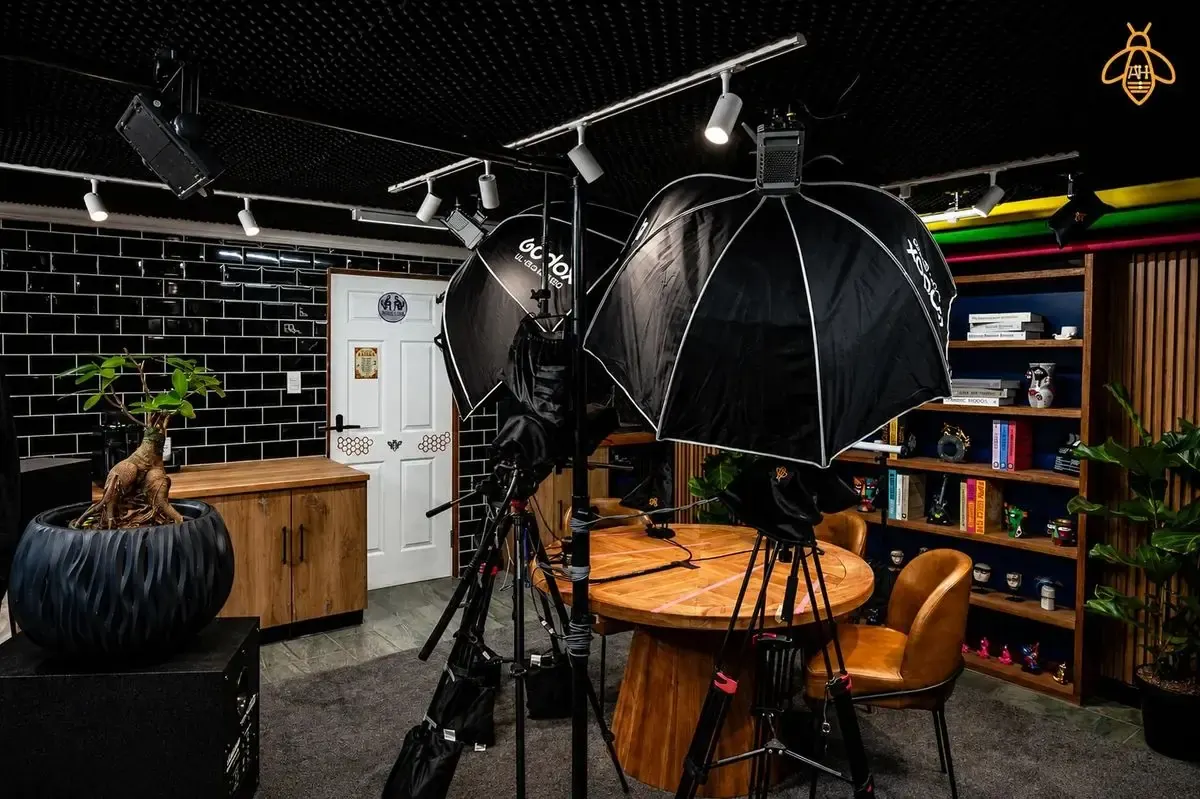
Where to record: our sister company The Think Tank SA runs a walk-in podcasting studio: professional microphones, acoustics and cameras, with an engineer, so you walk in with your expertise and walk out with broadcast-grade recordings. No equipment purchases, no garage acoustics, no excuses. Book a session, bring a guest, and the estate handles the rest of the pipeline from raw file to published clips.
Straight answers
The questions owners actually ask us.
Do I need expensive equipment to start?
No. You need a quiet room and a decent microphone to guest remotely, and nothing at all to guest in person. When you want broadcast-grade audio and video without buying anything, that is what the walk-in studio is for. Equipment is the last problem to solve, not the first; the first is having something worth saying.
I hate the sound of my own voice. Does that disqualify me?
Almost everyone hates their recorded voice at first: you are used to hearing yourself partly through your own skull, and the recording removes that. Listeners have no such baseline; they only ever hear the recorded version, and what they respond to is fluency and honesty, not timbre. Give it three recordings before you decide. If speaking genuinely is not your medium, we will say so and build your authority in writing instead.
How long before podcasting produces clients?
Longer than adverts, shorter than a book, and we will not pretend to a precise timeline, because it depends on how often you appear and how well the shows match your buyers. Treat it as trust infrastructure with a horizon of quarters, not weeks, running alongside channels built for immediate demand. The two do different jobs; neither replaces the other.
Can I just clip other people's podcasts instead of appearing on any?
Commentary on others' ideas has its place, but it builds the authority of the person being clipped, not yours, and reposting someone else's material wholesale is a copyright problem besides. The credential this page describes cannot be borrowed; it is minted one recorded hour at a time, in your own voice.
Should the show be about my industry or about me?
About your listener's problems, in your voice. Pure industry shop-talk finds peers, not clients; pure personality finds fans, not buyers. The working formula is your genuine expertise applied to questions your customers actually have, which is the same rule that governs every word we publish.

One clear next step
Find out if the microphone suits you.
Tell us about your business and we will map a guesting route: which South African shows your buyers actually hear, what you are credibly qualified to talk about, and whether a show of your own would ever be worth the commitment. If the honest answer is "you are a writer, not a talker", we will say so, and point your budget at the written word instead. The medium should fit the mouth, not the trend.
Map my guesting routeOr book the room first: The Think Tank SA walk-in studio.