
AutoHive's transparent CRM: every marketing package includes a GoHighLevel CRM where every lead, its source, every logged call and every deal's advertising origin is visible in real time. You can open it any hour. Hive Enterprise can commission a custom CRM build, quoted separately. An agency that lets you audit it daily has nothing to hide.

The transparent CRM
Stop taking your agency's word for it. Audit us daily.
The dirty secret of the agency industry is that reporting is theatre: screenshots, slides, and numbers you have no way to check. Our answer is structural, not rhetorical: every marketing package includes a GoHighLevel CRM where the results of our work land in real time, in a system you can open. This page explains what that means, what you can see, and when a custom CRM build on Hive Enterprise is the better fit.

The problem we are solving
Screenshot reporting asks for faith. You deserve evidence you can check.
Here is how agency reporting usually works. Once a month a PDF arrives with a lead count, a cost per lead and a chart heading pleasantly upward. Now ask the awkward question: how would you check any of it? The ad accounts are often in the agency's name. The agency set up the tracking. The agency built the report. Every link in the chain of evidence is held by the party being judged.
No auditor, bank or court would accept that arrangement. Most agencies do not invent numbers. The trouble is that honest and dishonest agencies produce identical-looking PDFs, so the report tells you nothing about which kind you hired. A report you cannot verify is not evidence. It is decoration.
There is a second problem inside the first. A monthly report usually mirrors a monthly rhythm of attention: an hour or two in your ad accounts, a few tweaks, then silence. A budget that starts leaking on day three can keep leaking until day thirty.
We fix both. Your ads are checked every day. From Hive Growth up, a weekly performance report lands in your inbox every Friday morning, drawn from Google Tag Manager, Google Ads, Microsoft Ads, Semrush and your blog. When that report and a GoHighLevel CRM included with every marketing package tell the same story, you have evidence, not faith.
Sample report
This is what lands in your inbox every Friday, from Hive Growth up.
One report, five sources, no padding. Before your weekend starts, you see exactly what your marketing did this week and what we did about it. Weekly reports are included on Hive Growth, Hive Scale and Hive Enterprise. Hive Starter reports monthly.
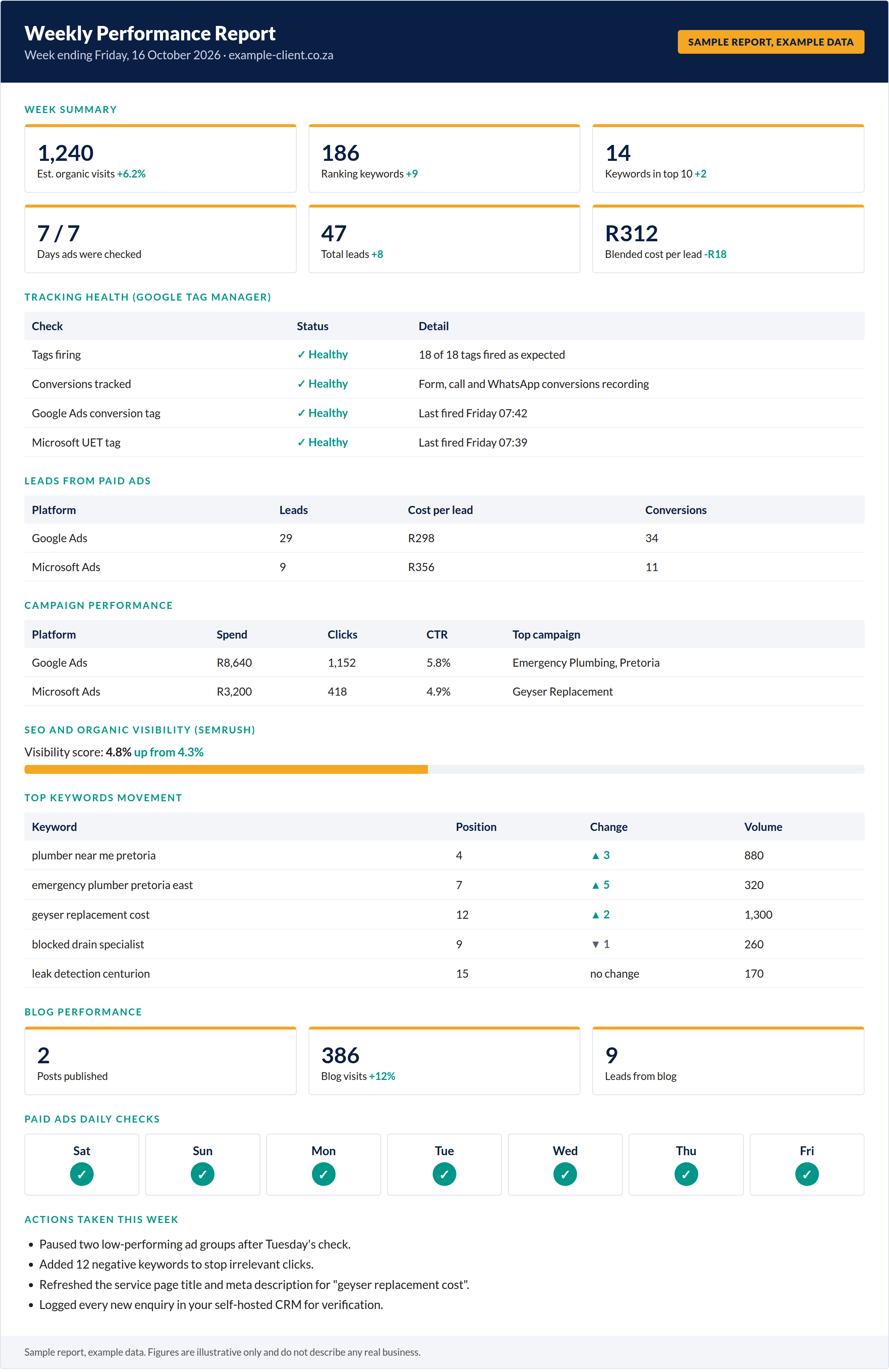
What each section tells you
- Week summary. The headline numbers at a glance: leads, cost per lead, traffic and rankings.
- Tracking health. Google Tag Manager confirms your tags are firing and conversions are recording. If tracking breaks, you hear about it from us, not from a quiet month.
- Leads from paid ads. Leads, cost per lead and conversions from Google Ads and Microsoft Ads, side by side.
- Campaign performance. Spend, clicks, click-through rate and the top campaign on each platform.
- SEO and organic visibility. Semrush data on how visible you are in search and which keywords moved.
- Blog performance. Posts published, visits and the leads your content brought in.
- Daily ad checks. Seven ticks for seven days. Proof the work happened, not a promise that it will.
- Actions taken. What we changed this week, and why.
Every number can be checked against your own CRM and ad accounts. That is the point.
Our answer
A GoHighLevel CRM, included with every marketing package.
Every AutoHive marketing package includes a GoHighLevel CRM: a login you hold, not a dashboard we keep. We configure it, wire your enquiries into it, and you can open it any hour. Here is what lands in it, continuously, without waiting for month-end. Hive Enterprise can commission a custom CRM build, quoted separately, when GoHighLevel is not the right fit.

Your leads, with their origins
Every enquiry arrives tagged with its source: which advert, which platform, which campaign, which search. When we say the advertising produced a lead, you can open the record and see the thread yourself, from the rand spent to the phone that rang.
See how the tracking is built
Your pipeline, live
Leads move through stages: new, contacted, quoted, won, lost. Every call, note and status change is logged as it happens. The pipeline is not a monthly summary of what we claim happened; it is the working record of what did happen, visible at 06:00 or 23:00, whenever you care to look.
Book a walkthrough with Tanya
Your data, visible and protected
Customer data lives in your GoHighLevel CRM, which you can open, search and export. You remain the responsible party for your customers' information under POPIA, the Protection of Personal Information Act, South Africa's data-protection law. We process that data as an operator on your behalf, and the system is set up so you can actually honour that duty.
Read who owns whatNotice what this does to the agency relationship. Reports still arrive, weekly from Hive Growth up and monthly on Hive Starter, but now they are summaries of a record you already hold, not claims you must take on trust. If a report ever disagreed with your CRM, you would catch it in minutes. That possibility, standing there permanently, is the discipline. An agency that lets you audit it daily has nothing to hide, and an agency that would rather you couldn't has told you something important.
Why you hold the login
Most agencies keep the CRM. You should hold it.
Typical agency reporting lives in a system the client never logs into. The leads, the sources and the pipeline sit behind the agency's wall, and the monthly PDF is the only view you are given. Every AutoHive marketing package includes a GoHighLevel CRM with a login you hold, so you can see the same record we see. A custom CRM build is offered on Hive Enterprise only, quoted separately, when GoHighLevel is not the right fit.
| The question that matters | Typical agency CRM | GoHighLevel, included with every package |
|---|---|---|
| Who holds the login? | The agency, if anyone outside the agency holds one at all. | You. We work in it with you. |
| What can you see? | A monthly PDF compiled for you. | Every lead, its source, the pipeline and the reporting, any hour. |
| Can you check the report against the record? | No. The record is theirs. | Yes. That is the point of including it. |
| What happens if the relationship ends? | The agency keeps the system; you hope for an export. | You keep the login and can export your records. We remove our access. |
| Who can lock whom out? | The agency can lock you out. | You can revoke our access. That is the correct direction. |
| Is a custom CRM available? | Rarely, or sold as a separate product. | Quoted separately on Hive Enterprise only. |
GoHighLevel is included with every marketing package because it is the evidence layer that makes every other line on the invoice checkable. We configure it, wire the enquiries and keep the setup honest; you hold the login. A custom CRM, built to your specification, is offered on Hive Enterprise and quoted separately.
The exit, written into the entrance
If you leave, you keep the login and the records.
Marketing is full of horror stories about endings: the agency that kept the ad account, the vanished tracking history, the customer database held politely to ransom until the final invoice was settled. We think the surest test of an agency's honesty is what it builds for the day you fire it. So here is our ending, stated at the beginning: you hold the GoHighLevel login from day one, and every contact, note and deal in it is yours to export. Off-boarding means we document the handover and remove our own access. The same principle covers your ad accounts, pixels and creative files; the digital assets page sets out the whole inventory.
This is not generosity; it is alignment. An agency whose clients can leave easily has to be worth keeping every single month: the work has to hold up in your reputation results, in your pipeline, in numbers you can check. Lock-in lets an agency relax. A login you hold keeps one honest. We chose the setup that keeps us honest, and we ask you to judge us inside it, in a pricing structure with no small print to hide behind.
One workshop pun, as tradition demands: other agencies keep the honey and show you a photograph of the hive. Here, you hold the login, and you can look inside whenever you like.
What watching actually looks like
A Tuesday morning in your CRM.
Abstractions hide things, so here is the concrete version. It is 07:40. You open your CRM with your coffee, before we have said a word to you. Overnight, three enquiries arrived: one from a Google search ad, tagged with the campaign and the search theme that triggered it; one from a Facebook video, tagged to the specific creative; one from your Google Business Profile listing. Each is already a record with a timestamp, a source and a status of new.
By 09:15 the first has been called; the call is logged, with a note. One enquiry becomes a quote by Thursday; the quote's value sits in the pipeline against the advert that started it. When it closes this month or next, the loop closes with it: rand of spend in, rand of revenue out, visible without asking anyone's permission. Nobody compiled this view for you, which is precisely why you can trust it.
Multiply that Tuesday by a year and you have something rare in marketing: an institutional memory of what actually works for your business, sitting in a CRM you can open. Agencies come and go. The evidence stays.
Straight answers
The questions sceptical clients ask, as they should.
What exactly does "managed" include?
Configuration of your GoHighLevel CRM, wiring of website and advertising enquiries, pipeline setup, source tags, and user administration for your team. You use the CRM; we keep the setup honest. If your own team later wants to run it without us, that is your right: you hold the login. We document the setup with a handover in mind from the first day, which is less dramatic than it sounds and exactly the point.
Can our own sales team work in it, or is it only for watching the agency?
It is a full CRM, and we encourage your team to live in it. Salespeople log calls, send quotes and move deals through the pipeline; the marketing data we generate flows into the same records. That convergence is where the real value sits: when the same system holds both the advertising source and the eventual sale, you can finally see which marketing actually produced revenue: not clicks, revenue. That closed loop is also what makes the ad platforms' targeting smarter about who to find next.
Who at AutoHive can see our customer data?
Only the named team members working on your account, under access you can view and revoke. We operate as an operator processing data on your behalf under POPIA, with your business as the responsible party; that relationship is put in writing, and our access exists at your pleasure, not the other way around. We never use one client's customer data to benefit another client.
What does a POPIA access or deletion request look like in practice?
When a customer exercises their rights to see, correct or delete their personal information, the record is in one place, in your GoHighLevel CRM, so the request can actually be honoured instead of chased across an agency's inbox, a rented ad platform and three spreadsheets. Data minimisation is a design habit here too: the CRM stores what serves the customer relationship, not everything that could conceivably be hoarded.
What if AutoHive itself closed its doors tomorrow?
You would still hold the GoHighLevel login and the records in it. GoHighLevel is a third-party platform, not our infrastructure, so the CRM does not depend on AutoHive staying open. We document the setup from day one so another operator, or your own team, can pick it up. We plan to be here, but a promise that survives the promiser is the only kind worth writing for.
How quickly is the CRM live after we sign?
Provisioning is part of onboarding, and the GoHighLevel CRM is live before the first campaign runs: the evidence layer has to exist before there is anything to evidence. Lead capture from your website and advertising is wired in during the same setup, so from the first rand of spend there is never a period where results happen off the record.
How is the CRM secured and backed up?
GoHighLevel provides the platform's encryption, access controls and backups. On our side: named users only, access you can revoke, and a documented setup. Those are our standing responsibilities, not a separate line item, and because the arrangements are documented, they are inspectable, which is the house style by now.
Can we export our data whenever we like?
Yes: contacts, deals, notes and history, in standard formats, at any time, without asking us and without a fee. It may seem odd to advertise the exit on the sales page, but an export button you can press without permission is the entire ownership argument in one control. Systems that make leaving easy are the only systems that deserve your staying.
Is our customer data used to improve other companies' products, or shared with the ad platforms?
Never used to improve anyone else's product, never pooled, never sold. Where conversion data is shared with an advertising platform to improve campaign performance, it happens under your instruction, for your campaigns, using the platforms' consented mechanisms, and it is visible in the setup we document. The distinction matters: using your data in your service, at your direction, is the job; using it for anything else is a breach, and we treat it as one.
Is the CRM an extra cost on top of the marketing packages?
No. A GoHighLevel CRM is included with every marketing package; the pricing page shows the numbers in public. We fold it in deliberately: the CRM is not an upsell, it is the evidence layer that makes every other line on the invoice checkable. A custom CRM build is offered on Hive Enterprise only, quoted separately. Charging you extra for the ability to verify us would rather miss the point.

One clear next step
Ask to see a live CRM walkthrough.
The argument on this page is structural, so the proof should be too. Book 30 minutes with Tanya and she will walk you through a working GoHighLevel CRM, set up the way we run it for clients: the lead records, the source tags, the pipeline and the parts an agency would normally keep out of view. Bring your most sceptical colleague; this page was written for them.
Book a CRM walkthrough with TanyaOpen the booking calendar in a new tab if the calendar does not load.
Or read exactly who owns what when an agency relationship ends.